
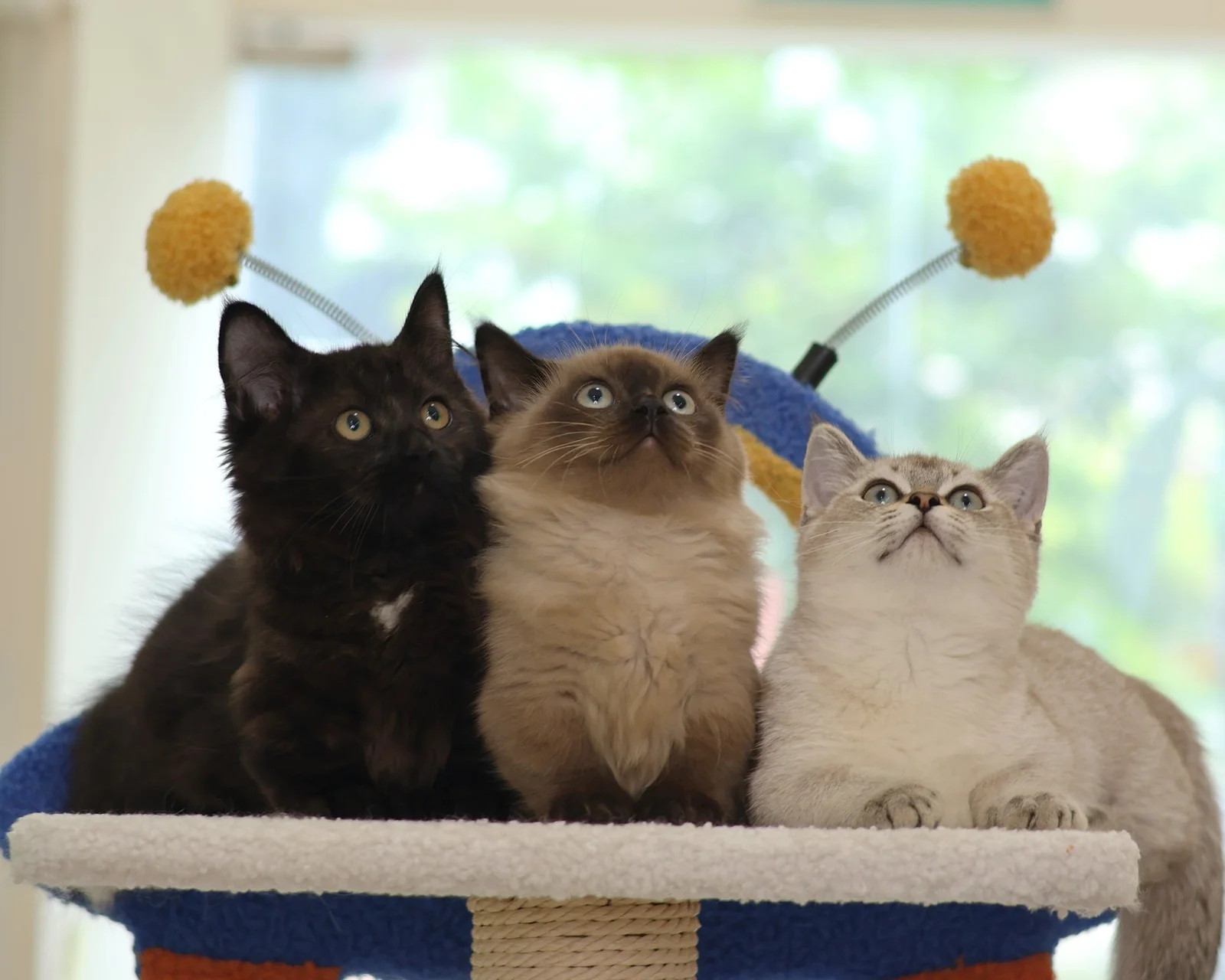
Kitten Socialisation in Singapore: Why Where a Kitten Grows Up Shapes Its Personality for Life
A kitten's socialisation window lasts only a few weeks. Learn what proper socialisation looks like, how a good cattery does it, and what HDB cat owners in Singapore need to know.
When choosing a kitten, most first-time cat owners in Singapore focus on breed, coat colour, and price. But there is one factor with a far deeper impact on your cat's personality, health, and quality of life for the next fifteen-plus years — and it is the one most often overlooked: socialisation.
A kitten that has been properly socialised in a real home environment and a kitten raised in a cage with minimal human contact will behave like two completely different animals once they arrive at your home.
In this guide, we cover everything in detail: what kitten socialisation actually is, why the golden window is irreversible, how a responsible cattery runs its socialisation programme step by step, how big the difference really is between a socialised and an unsocialised cat, and the extra adaptation training kittens need for life in Singapore's "vertical city".
If you're preparing to welcome a kitten home in Singapore, this article is worth ten minutes of your full attention.
1. What Is Kitten Socialisation?
Kitten socialisation means systematically and positively exposing a kitten — during the critical stage of brain development — to a wide variety of people, animals, sounds, environments, and everyday handling, so that one core belief is wired into its mind at the deepest level: the world is safe, and humans can be trusted.
The Golden Window: Roughly 2–9 Weeks, Extending to About 14 Weeks
A cat's socialisation window opens remarkably early — at around 2 weeks of age — peaks by week 9, and gradually closes by roughly 14 weeks. During this stage, a kitten's brain absorbs information about the world like a sponge:
- Things encountered during this window are filed away as normal and safe;
- Things not encountered during this window are far more likely to be classified as threats when first met later in life.
This is why socialisation is largely irreversible. Once the window closes, behaviour modification in adulthood can produce improvement, but typically only reaches tolerance — rarely genuine relaxation and affection. Many rescued community cats, even after years of loving care, still won't allow themselves to be picked up or have their belly touched. The root cause is a missed window in kittenhood.
And here's the key point: this entire window plays out at the cattery. By the time you bring your kitten home, its "factory settings" are essentially locked in. That is exactly why the cattery's socialisation work matters so much.
What Does Socialisation Training Cover?
A complete programme spans seven areas:
① Human contact. The kitten is gently stroked and held by a variety of people — men, women, the elderly, children, people wearing hats or glasses. Multiple short, gentle sessions per day work better than one long one. The goal is to firmly associate human touch with good things: treats, play, warmth.
② Body-handling desensitisation. Paws, ears, mouth, belly, and tail are touched regularly and paired with treats. This lays the foundation for a lifetime of stress-free care: nail trims, tooth brushing, ear cleaning, and vet examinations all depend on a cat that tolerates being handled.
③ Environment and sound habituation. The kitten naturally hears vacuum cleaners, doorbells, television, hair dryers, and dishwashing in daily life (starting at low volume and building up gradually), and explores different floor textures, cardboard boxes, tunnels, cat trees, and rooms. Recordings of thunder or a baby crying can be used for preventive desensitisation.
④ Carrier and travel training. The carrier sits open in the living area as a normal piece of furniture, with a soft mat and treats inside, so the kitten enters voluntarily and even naps in it — rather than the carrier appearing only on vet day. Short car rides follow, so that "going out" never equals "disaster".
⑤ Contact with other animals. Under safe, supervised conditions, the kitten interacts with stable adult cats — above all its mother and littermates. It is precisely through rough-and-tumble play with siblings that a kitten learns bite inhibition (bite too hard and the game stops) and proper cat-to-cat etiquette.
⑥ Play rules. Play always happens with wand toys and teasers — never with hands or feet. If the kitten bites a hand, the interaction stops immediately, teaching it from day one that biting ends the game and hands are not prey. This is the single best prevention for adult cats that pounce on and bite their owners.
⑦ Alone-time tolerance. The kitten gradually gets used to short periods alone, preventing over-dependence and reducing the risk of separation anxiety later in life.
Three Principles That Run Through Everything
- Positive reinforcement only: treats, praise, and play as rewards — never punishment, never force;
- Short and sweet: each session ends while the kitten still wants more;
- Read the body language: airplane ears, puffed fur, or hissing means back off immediately and reduce the intensity.
2. How a Professional Cattery Does It: A Complete Timeline from Birth to 12 Weeks
Socialisation is not just "petting the kittens more often". It is a structured programme that begins on day one. A responsible cattery typically follows this rhythm:
Weeks 0–2 (Neonatal Stage): Early Gentle Handling
Each kitten receives brief, gentle handling and weighing every day — just a few minutes at a time. This practice, known as early gentle handling, is supported by research: kittens that experience it grow up friendlier toward people and less reactive to stress. Just as importantly, the cattery keeps the mother cat calm and relaxed — because when mum is at ease, her kittens learn that humans showing up means no threat.
Weeks 2–7 (The Core Window): Intensive, Progressive Exposure
This is the most critical stage of the entire process. A quality cattery deliberately arranges:
- Varied human contact: people of different genders, ages, voices, and scents gently stroke and hold every kitten, every day;
- Raising kittens in the family living area: the nest sits in the living room — not an isolated cattery room — so kittens naturally hear vacuuming, TV, dishwashing, doorbells, and conversation;
- A rich exploration environment: different floor textures, boxes, tunnels, and climbing structures that build confidence with new things;
- The start of body-handling desensitisation: paws touched, ears and mouth checked, belly stroked — always paired with a reward.
Weeks 7–12: Learning the Rules, Rehearsing Real Life
- Continued life with mum and littermates: this is where bite inhibition and feline social etiquette are learned — and the core reason responsible catteries insist kittens stay until at least 12 weeks of age;
- Wand-toy play only: hands are never used as toys, cementing the "hands are not prey" rule;
- Carrier normalisation: the carrier stays open in the play area; kittens wander in and out and rest inside voluntarily;
- Short car rides: for example, combining vaccination trips with travel practice;
- Grooming rehearsals: brushing, nail trims, and (for long-haired kittens) blow-drying, introduced one step at a time;
- Cross-species contact (where appropriate): meeting calm adult cats or friendly dogs.
How to Verify a Cattery Actually Does This: Six Checks That Beat Any Sales Pitch
- Are the kittens raised in a home, or kept in cages?
- Can you see the kittens' daily life on video?
- When you visit, do the kittens come up to greet you — or scatter and hide?
- When a stranger picks a kitten up, is its body relaxed or stiff?
- Does the cattery insist on keeping kittens until at least 12 weeks? (Be wary of anyone willing to sell at 8 weeks.)
- Can the breeder describe specifically what socialisation they do — rather than brushing it off with "all our cats are friendly"?
At NekoTown, every kitten is raised in a home environment — from the day they open their eyes, the sounds they hear are the sounds of real family life, and the touch they know is a gentle daily embrace. We warmly invite you to book a kitten viewing and put us to the test against all six checks above.
3. Socialised vs Unsocialised: How Big Is the Difference, Really?
Bring the two types of kitten home and the differences show up in every corner of daily life — and they grow more pronounced with age:
| Aspect | Well-Socialised Kitten | Unsocialised Kitten |
|---|---|---|
| Settling into a new home | Adapts within hours to days; explores confidently | Hides for weeks; may refuse food; stress diarrhoea |
| Attitude toward the owner | Affectionate, seeks petting, can be held | Fearful, avoidant; may hiss, scratch, or bite |
| Visitors | Curious or unbothered | Vanishes at the doorbell; may bond with one person only — or no one |
| Nail trims, medication | Generally cooperative | A wrestling match every time; needs two people or a towel wrap |
| Vet visits | Low stress; vet can examine normally | Severe stress; may require sedation just to be examined |
| Play style | Knows hands aren't prey; bites with restraint | Pounces on hands and feet; no bite control |
| Noise and change | Adapts quickly | Vacuum cleaners, moving house, and guests are all crises |
| Multi-cat introductions | Understands feline etiquette; introductions go smoothly | Can't read other cats' signals; fights or long-term standoffs |
| Adult temperament | Stable and relaxed | Chronically vigilant, high baseline anxiety |
Three Differences Worth Dwelling On
① The difference is irreversible. The "humans = safe" belief formed during the window is wired in at the deepest level. After the window closes, patient taming can improve an adult cat — but the ceiling is usually tolerance, not true relaxation and attachment.
② Bite inhibition can only be learned from littermates. Kittens separated from their mother and siblings too early (before 8 weeks) never get the rough-and-tumble feedback that teaches them how hard is too hard. They grow into adults that bite painfully during play — the root cause of a huge share of "my cat bites me" problems, and exhausting to correct later.
③ Stress isn't just a behaviour problem — it's a health problem. Chronically anxious cats are more prone to feline idiopathic cystitis, overgrooming, and stress-related digestive issues. Anxiety genuinely shortens a cat's healthy lifespan and erodes its quality of life.
For the owner, this is a fundamental difference in effort and experience: with a well-socialised cat, you enjoy cat ownership from day one; with an unsocialised one, the first year or two may be consumed by behaviour correction — with limited results.
To be fair: unsocialised cats (rescued strays, for instance) are not "bad cats". They can absolutely form deep bonds with their owners — they simply express it more subtly and need far more patience. But if you are choosing a kitten from a cattery, socialisation quality deserves a higher priority than price.
4. What You Gain by Bringing Home a Well-Socialised Kitten
When you take home a properly socialised kitten from a professional cattery, the benefits are concrete and lifelong:
- Affectionate and quick to bond — typically settles in within days, actively seeking petting and cuddles, instead of spending weeks under the bed;
- Minimal relocation stress — eats normally and uses the litter box sooner; far lower risk of stress diarrhoea or urinary blockage;
- Effortless daily care — cooperates with nail trims, medication, tooth brushing, and grooming; a benefit you'll cash in repeatedly across fifteen-plus years;
- Stress-free vet visits — a cat that's at home in its carrier travels calmly, cooperates during exams, and gets more accurate diagnoses;
- Fewer behaviour problems — no biting, no ankle ambushes; and kittens that lived with their litter until 12 weeks make second-cat introductions far easier;
- Friendlier in busy households — no fear or aggression toward specific groups such as men or children.
In short: the cattery has already completed the most critical, most irreversible work — what you receive is a cat with excellent factory settings.
This is also why NekoTown can confidently offer a Personality Guarantee: we promise that the kitten placed in your arms is friendly and affectionate. If, after the 30-day adjustment period, your kitten still struggles to bond with you, we will replace it with a kitten of equal quality. We can make this promise because every NekoTown kitten has completed the full home-based socialisation programme described above.
5. Raising a Kitten in Singapore Is Different: 5 Extra Adaptations for HDB High-Rise Life
Singapore's living environment and regulations differ markedly from most countries, and a kitten's socialisation priorities shift accordingly. Here are five things every Singapore cat owner should know:
① Indoor, High-Rise Living Is the Default — Window Safety Is Lesson One
Cats in Singapore are indoor cats for life, so outdoor desensitisation (grass, gardens) matters little here. What matters instead is indoor enrichment: cat trees, window perches, and varied play. And window safety must be taken seriously: according to SPCA Singapore, they receive at least 5 cases of Feline High-Rise Syndrome per week — roughly 250 falls a year, with at least half fatal on impact. Install window mesh or grilles before your kitten arrives, and let it grow up treating protected windows as a normal part of its world.
② Sound Desensitisation, HDB Edition
HDB and condo life comes with its own soundtrack: lift chimes, neighbours' footsteps in the corridor, upstairs renovation drilling (nearly unavoidable in Singapore, and it goes on for weeks), and void-deck announcements. On top of that, Singapore's thunderstorms are extremely frequent — thunder desensitisation is practically a compulsory subject here. A kitten raised inside a real home has a far higher tolerance for this urban symphony.
③ Harness and Carrier Aren't Optional — They're the Law
Under Singapore's rules, cats in public must wear a harness or stay inside a carrier; free roaming is not permitted. That makes harness training and carrier habituation legally required basics in Singapore. Vet trips usually happen by Grab or taxi, so kittens also need to be comfortable with unfamiliar cars and drivers. Every NekoTown kitten completes carrier normalisation before leaving us, and the starter kit includes a compliant carrier — so you can bring your kitten home safely and legally on day one.
④ Tropical-Climate Grooming Needs Extra Groundwork
Year-round heat and humidity mean cats move constantly between air-conditioned and non-air-conditioned spaces; long-haired cats need more frequent brushing; and baths must be followed by prompt blow-drying to prevent skin issues. Brush and hair-dryer desensitisation therefore needs to be more thorough here than in cooler countries. The brush in our starter kit is the same type your kitten is already used to at the cattery — a seamless handover.
⑤ Adapting to Singapore's Multi-Generational, Multilingual Homes
Singapore households often include live-in helpers and grandparents; homes are busy, languages are varied, and HDB neighbours are close by. A kitten that grew up around different faces, different vocal tones, and daily cleaning routines (mops, vacuums) will settle into such a home with ease.
📌 Regulatory Reminder: 31 August 2026 Is the Key Date
If you're planning to own a cat in Singapore, make sure you know the following:
- Under the AVS Cat Management Framework, all pet cats must be microchipped and licensed by 31 August 2026 (the end of the two-year transition period);
- From 1 September 2026, keeping an unlicensed cat is an offence, carrying a fine of up to S$5,000; licensing is free during the transition period;
- First-time licence applicants must complete a one-time pet ownership course of about 30 minutes;
- HDB flats may keep a maximum of two cats per household — so if you're considering a second cat down the road, your first cat's feline social skills matter even more.
The good news: every NekoTown kitten is delivered with an ISO-standard microchip already implanted, plus an AVS Cat License that meets Singapore's regulatory requirements — the compliance paperwork is handled for you, so all you need to do is welcome your new family member home.
6. Socialisation Is Just the Beginning: NekoTown's Complete Assurance System
A great temperament is half of a happy cat's life; the other half is physical health. At NekoTown, beyond being affectionate, every kitten comes with comprehensive health and after-sale protection:
🩺 Health Assurance
- Rigorous health checks: every kitten is fully vaccinated, up to date on monthly deworming, and accompanied by a Health Certificate issued by a Singapore-licensed government veterinarian;
- Genetic screening of both parents: every sire and dam is DNA-tested — including screening for HCM (hypertrophic cardiomyopathy) and PKD (polycystic kidney disease) — ensuring kittens carry no detectable fatal hereditary or congenital conditions;
- Pedigree certification: each kitten comes with a Pedigree Certificate from an internationally recognised registry (TICA, GCCF, etc.) and the parents' Genetic Test Reports.
🛠️ Four Core After-Sale Promises
- 7-Day Medical Support: within the first 7 days at home, treatment costs for common conditions — sneezing, minor skin issues, or ear infections — are covered by the cattery;
- 30-Day Full Refund: if your kitten is diagnosed with a serious illness or sadly passes away within 30 days of going home, the purchase price is fully refunded;
- Lifetime Genetic Protection: lifetime coverage against fatal hereditary or congenital diseases;
- Personality Guarantee: we promise a friendly, affectionate companion. If your kitten still struggles to bond after the 30-day adjustment period, we will replace it with a kitten of equal quality.
🎁 The Full Starter Kit — Everything Included, Ready from Day One
To give your kitten a smooth, comfortable transition into its new home (which is itself the final stage of socialisation), the price already includes every essential and every health document:
Daily Life & Care
- The same cat food your kitten is used to at the cattery — continuity of diet prevents food-switch stress
- Food bowl
- Litter box
- Carrier — the same one your kitten has already been trained with
- Brush
- Nail clipper
- Scratching board
- Toys and cat teasers — continuing the correct "hands are not prey" play habit
Health & Vaccination Documents
- Complete Vaccination Card
- ISO-standard Microchip (implanted)
- Up-to-date Deworming records
- Health Certificate issued by a Singapore-licensed government veterinarian
Certification & Reports
- Pedigree Certificate from TICA / GCCF or another internationally recognised registry
- Parents' Genetic Test Reports (screened for HCM/PKD)
- AVS Cat License compliant with Singapore regulations
💡 Notice the design logic behind this kit: it is socialisation principles extended into your home. Familiar food, the same carrier, the same brush and toys — a seamless handover from cattery to your living room that keeps relocation stress to an absolute minimum.
7. One Last Tip: Come in Person and Find the Kitten That Chooses You
Every NekoTown kitten goes through the same complete socialisation programme, and every one of them is gentle and people-loving. But just like people, each kitten has its own personality — some are playful little dynamos; others are calm souls who'd rather purr in your lap all evening.
Photos and videos can show you a kitten's looks, but they can't convey what it feels like to hold one in your arms. That's why our FAQ has always strongly encouraged prospective owners to book a kitten viewing before deciding — come hold them, play with them, interact with them. You'll find that the kitten truly meant for you usually picks you the moment you lift it up.
After all, this is a bond of fifteen years or more — it deserves one proper meeting.
NekoTown — kittens raised in a home, sent home with guarantees. Book a Kitten Viewing →
Kitten socialisation FAQ
Common questions for Singapore families preparing to bring a kitten home.